> For the complete documentation index, see [llms.txt](https://docs.mindnetwork.xyz/mind-lake-sdk/llms.txt). Markdown versions of documentation pages are available by appending `.md` to page URLs; this page is available as [Markdown](https://docs.mindnetwork.xyz/mind-lake-sdk/typescript-api-reference/mindlake.md).
# MindLake
## 1. connect() Method
Connect to Mind Lake while ensuring that all encryption keys are prepared and available. Prior to making any function calls within the SDK, execute this function as it serves as the entry point.
```typescript
const mindLake = await MindLake.getInstance(appKey);
const res = await mindLake.connect(chainId);
```
### Parameters
1. `appKey` - `string`: used for authorization, allowing users of your application to gain access to Mind Lake. **As a developer, you can apply for APP Keys from Mind Scan.**
2. `chainId`- `string|number`: the ID of the supported chain.
### Returns
An object of `Promise<`[`ResultType`](#user-content-fn-1)[^1]`>`. [For more information](#2.-resulttype-type).
{% hint style="info" %}
**Wallet Interaction**
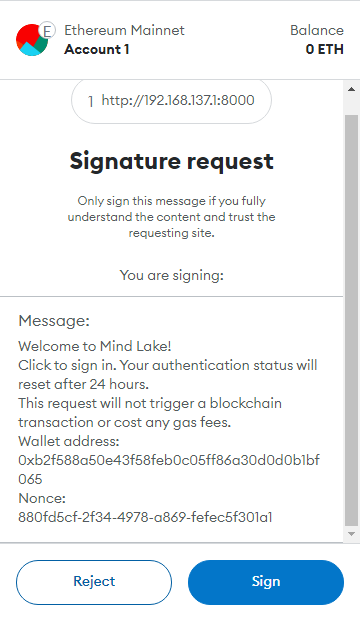
During the 'Connect' procedure, the wallet will prompt the user 2-3 times as follows:
1. Sign a nonce for login authentication.
 **If the user's account keys are already on the chain:**
2. Decrypt the user's account keys using the wallet's private key.
**If the user's account keys are already on the chain:**
2. Decrypt the user's account keys using the wallet's private key.
 **If the user's account keys do not exist yet:**
2. Obtain the public key of the wallet, which is used to encrypt the randomly generated account keys.
**If the user's account keys do not exist yet:**
2. Obtain the public key of the wallet, which is used to encrypt the randomly generated account keys.
 3. Sign the transaction to upload the encrypted key ciphers to the smart contract on the chain.
 {% endhint %}
### Example
```typescript
const mindLake = await MindLake.getInstance("YOUR_OWN_APP_KEY");
//"5" is example of Goerli Testnet chainId
const chainId = "5"
const res = await mindLake.connect(chainId);
```
## 2. MindLake.ResultType
Every method call in the Mind Lake SDK returns an object of ResultType.
```typescript
type ResultType = {
code: number,
message?: string,
result?: any
}
```
* `code` - `number`: The return code of the method call. A return value of 0 indicates success, while non-zero values represent a specific error code.
* `message` - `string`: If the return code is non-zero, an error message will be provided to describe the specific error encountered during the method call.
* `result` - `any`: If a method call returns a result, it will be stored in the `result` field.
## 3. MindLake.DataType
The `DataType` enum defines a comprehensive range of supported data types. This enum can be used in conjunction with the `MindLake.DataLake.Column` class, which represents a single column in a table, to specify the data type of the column. By utilizing the `DataType` enum, you can ensure that your data is stored in the appropriate format and can be processed correctly by the system.
### Members
1. int4
2. int8
3. float4
4. float8
5. decimal
6. text
7. timestamp
[^1]: ```typescript
type ResultType = {
code: number,
message?: string,
result?: any
}
```
{% endhint %}
### Example
```typescript
const mindLake = await MindLake.getInstance("YOUR_OWN_APP_KEY");
//"5" is example of Goerli Testnet chainId
const chainId = "5"
const res = await mindLake.connect(chainId);
```
## 2. MindLake.ResultType
Every method call in the Mind Lake SDK returns an object of ResultType.
```typescript
type ResultType = {
code: number,
message?: string,
result?: any
}
```
* `code` - `number`: The return code of the method call. A return value of 0 indicates success, while non-zero values represent a specific error code.
* `message` - `string`: If the return code is non-zero, an error message will be provided to describe the specific error encountered during the method call.
* `result` - `any`: If a method call returns a result, it will be stored in the `result` field.
## 3. MindLake.DataType
The `DataType` enum defines a comprehensive range of supported data types. This enum can be used in conjunction with the `MindLake.DataLake.Column` class, which represents a single column in a table, to specify the data type of the column. By utilizing the `DataType` enum, you can ensure that your data is stored in the appropriate format and can be processed correctly by the system.
### Members
1. int4
2. int8
3. float4
4. float8
5. decimal
6. text
7. timestamp
[^1]: ```typescript
type ResultType = {
code: number,
message?: string,
result?: any
}
```